NICEIC Registered
Guides
RCD types: AC, A, F and B explained
Which RCD types go in UK homes, why Type AC is now restricted, and when you need Type F or Type B.
Published · Updated · By 2K Electrical Services
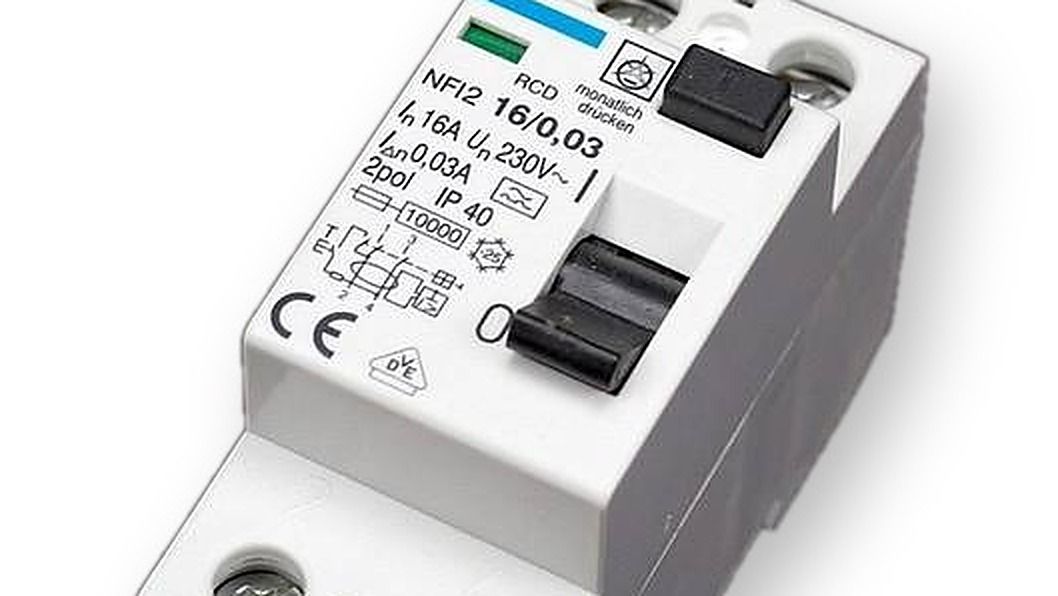
An RCD switches the power off when current leaks to earth, but not every RCD can see every kind of leak. Modern appliances are full of electronics, and they leak current in shapes that older RCDs were never designed to detect. That is why the type of RCD now matters as much as its rating. This guide covers the devices you will find in a home, the difference between Type AC and Type A, and what the current Wiring Regulations, BS 7671:2018+A4:2026, require. For how an RCD works and how to test it, see What is an RCD?.
Where RCDs sit in a home
- RCCB in a split-load board. One RCD protects a whole row of circuits. These boards were common in the 2000s and 2010s, but a single fault switches off everything on that side.
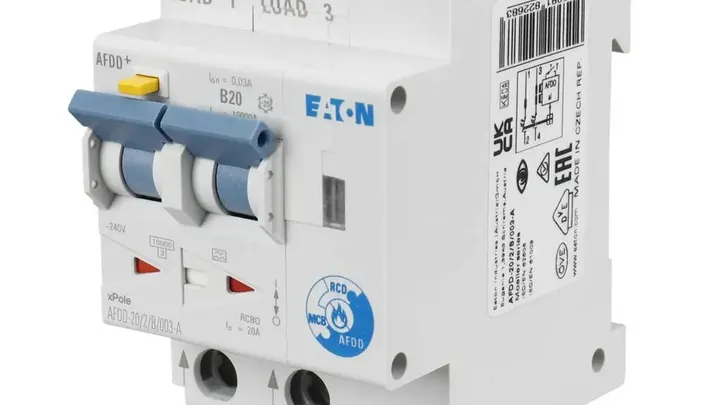
- RCBO for each circuit. An RCD and a circuit breaker in one device, so a fault on one circuit only switches off that circuit. This is the usual choice in a new consumer unit.
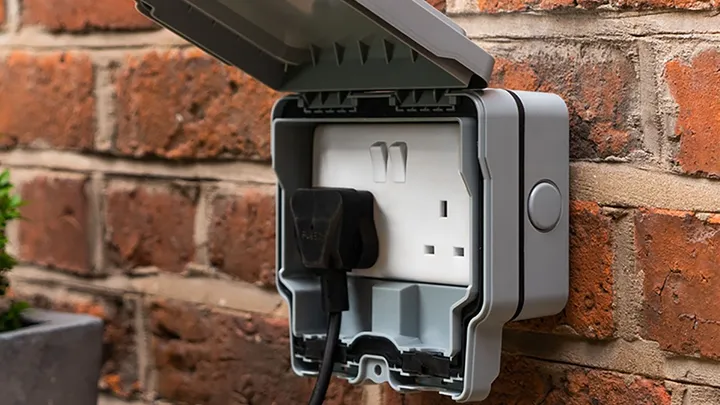
- RCD socket-outlets. A socket with its own RCD built in, protecting only what is plugged into it.
- Time-delayed RCD at the origin. In homes with their own earth electrode, a TT supply, a 100 mA time-delayed device marked S often protects the whole installation, with 30 mA devices after it. The S stands for selective: it describes a delay, not a type.
The four types
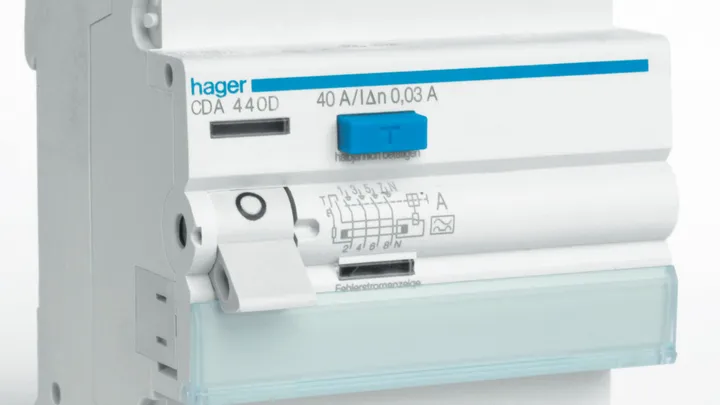
The type tells you which shapes of leakage current the RCD can detect. It is marked on the front, as a letter or a small symbol.
- Type AC detects only ordinary alternating current, the smooth sine wave. It was the standard UK device for decades.
- Type A detects everything Type AC does, plus pulsating direct current: the lopsided leakage produced by LED drivers, induction hobs, washing machines and other appliances with electronic controls. It keeps working with a small amount of smooth DC on the circuit, up to 6 mA.
- Type F does everything Type A does and also handles the mixed-frequency leakage from appliances with variable-speed motors, such as some washing machines, heat pumps and air conditioning units. It also tolerates more smooth DC than Type A.
- Type B detects smooth DC leakage as well, which the others cannot. It is used where equipment can produce smooth DC fault current, for example some solar inverters and EV chargers without their own DC protection.
Why Type AC is no longer the default
Pulsating DC from electronics can pass a Type AC RCD unnoticed, and smooth DC can saturate its core and blind it, so it may not trip when it should. Regulation 531.3.3 of BS 7671 therefore says a Type AC RCD may only be used to serve fixed equipment where it is known that the load current contains no DC components.
Sockets, lighting with LED drivers and most kitchen appliances do not meet that test, so for general circuits in a home the minimum is now Type A. Type AC is restricted rather than prohibited outright, and most new consumer units now come with Type A devices as standard.
New in Amendment 4: RCDs in series
Amendment 4 adds a note to Regulation 531.3.3: where RCDs are connected one after another, every one of them should suit the leakage the load can produce. A device further down the line, chosen for difficult loads, can blind the one upstream of it. In practice:
- Type AC should not be fitted upstream of Type A, F or B.
- Type A should not be fitted upstream of Type F or B.
- Type F should not be fitted upstream of Type B.
The one exception is a Type B further down the line: an AC, A or F device may sit upstream of it where the RCD manufacturer specifically declares the combination suitable. This matters most when a Type B device for an EV charger or a solar inverter is added to an older board that still has a Type AC main RCD.
EV chargers
Section 722 of BS 7671 requires each charging point to have its own RCD of at least Type A, and protection against DC fault current as well. That means either a Type B RCD, or a Type A or F RCD together with a device that disconnects the supply if DC fault current rises above 6 mA, known as an RDC-DD. Most home chargers now have the RDC-DD built in, so a Type A RCBO in the consumer unit is usually enough, but the charger’s installation instructions decide.
Inverters, heat pumps and other electronics
Solar inverters, battery storage, heat pumps and appliances with variable-speed motors can all produce DC or mixed-frequency leakage. BS 7671 expects the RCD to suit the equipment, and the equipment manufacturer usually states the type required in its installation instructions. If they ask for Type F or Type B, that is what has to be fitted.
What it means for your home
- A newer board with Type A RCBOs covers ordinary household circuits, including modern appliances.
- An older board with Type AC devices is not unsafe on its own. It does need checking before you add an EV charger, solar panels, a battery or a heat pump, and upgrading to Type A RCBOs is often the simplest answer.
- Whatever the type, press the test button every six months. If the RCD does not trip, call an electrician.