2K Electrical Services London

Guides

IP ratings: what the numbers mean

Reading the two digits on a fitting before you put it in a bathroom or garden.

Published · Updated · By 2K Electrical Services
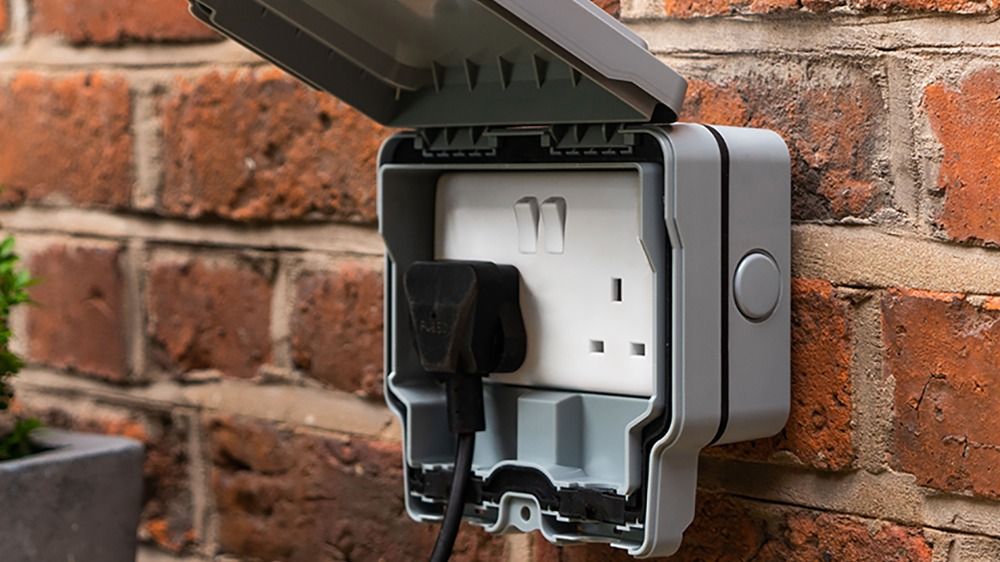
A weatherproof outdoor double socket on a brick wall, with its cover open and a plug connected
How to read an IP rating An IP rating has two digits. The first, 0 to 6, is protection against solid objects and dust. The second, 0 to 8, is protection against water. Examples: IP44 for bathroom zones 1 and 2, IP65 for outdoor lights and sockets, IP68 for submerged pond pumps. HOW TO READ AN IP RATING IP stands for Ingress Protection (BS EN 60529). Higher digit, better sealed. IP 6 5 1st digit · solid objects and dust (0–6) 2nd digit · water (0–8) An “X” in place of a digit means that property was not tested, not that there is no protection (IPX4 is common on bathroom fittings). SOLIDS 0 no protection 1 objects over 50 mm (back of a hand) 2 objects over 12.5 mm (a finger) 3 objects over 2.5 mm (tools, thick wire) 4 objects over 1 mm (thin wire, screws) 5 dust protected 6 dust-tight WATER 0 no protection 1–2 dripping water 3 spray up to 60° from vertical 4 splashing from any direction 5 low-pressure water jets 6 powerful water jets 7–8 temporary / continuous immersion IPX4 bathroom zones 1 and 2 IP65 outdoor lights and sockets IP68 submerged pond pumps
How to read the two digits of an IP rating. Swipe sideways to see the whole diagram.

Every light fitting, socket, fan or enclosure carries an IP rating (Ingress Protection, from BS EN 60529). The two digits tell you how well the casing keeps out solids and water. An X in place of a digit means the product has not been tested for that type of ingress, not that it has no protection.

First digit: solid objects and dust

Digit Protects against
0 Nothing
1 Objects larger than 50 mm, such as the back of a hand
2 Objects larger than 12.5 mm, such as a finger
3 Objects larger than 2.5 mm, such as tools and thick wires
4 Objects larger than 1 mm, such as thin wires and screws
5 Dust that could interfere with the equipment
6 Completely dust-tight

Second digit: water

Digit Protects against
0 Nothing
1 Dripping water falling vertically
2 Dripping water when the enclosure is tilted up to 15°
3 Spraying water at up to 60° from vertical
4 Splashing water from any direction
5 Low-pressure water jets from any direction
6 Powerful water jets and heavy seas
7 Temporary immersion up to 1 m
8 Continuous immersion beyond 1 m, as specified by the manufacturer

Where the common ratings fit

  • IP20 is the typical indoor rating for a switch or downlight in a dry room.
  • IPX4 or better is required in bathroom zones 1 and 2 (BS 7671 Section 701); choose IP44 as a minimum there, and IP65 directly over a shower if you want a margin.
  • IPX5 is required where water jets are likely, for example in a wet room that is hosed down.
  • IP65 to IP66 is the sensible choice for garden lights, outdoor sockets and external junction boxes.
  • IP67 and IP68 are for pond lights, underground joints and anything that may sit in water.

Always check the manufacturer’s instructions as well as the rating: a fitting may be IP65 but still unsuitable for a particular zone or for mounting in a ceiling.
More guides

Electrical certificates and Part P EIC, Minor Works or EICR, which electrical work has to be notified to building control, and what to keep for when you sell. PAT testing: what the law requires What the law actually says about portable appliance testing, how often equipment needs checking, and what the tests measure. Why does my RCD keep tripping? How to find out what is tripping your RCD, the most common causes, and when to stop resetting it and call an electrician. AFDDs: arc fault protection explained What an arc fault detection device does, where BS 7671 requires one, and where it is recommended. Fire alarms for homes and HMOs Smoke, heat and CO alarms, what Grade D1 and LD2 mean, and the rules for new homes, rented homes and HMOs in England. Home CCTV: cameras, NVRs and the law Camera types, wired and wireless systems, NVRs, night vision and keeping cameras secure, plus what the law expects when a camera sees past your boundary. Home Wi-Fi and mesh explained Wi-Fi standards and bands in plain English, how mesh compares with extenders and access points, and why a data cable is the biggest upgrade. RCD types: AC, A, F and B explained Which RCD types go in UK homes, why Type AC is now restricted, and when you need Type F or Type B. Surge protection (SPDs) explained What a surge protection device does, when the Wiring Regulations call for one, and which type your home needs. Earth fault loop impedance explained Why electricians measure Zs and Ze, and what the limits in BS 7671 mean for your installation. Bathroom electrics: common questions Can you have a socket, a switch, a fan or a light over the bath? Plain answers from Section 701. Bathroom zones under BS 7671 How zones 0, 1 and 2 are measured, and the RCD and bonding rules that come with them. EICR codes explained What C1, C2, C3 and FI mean on your report, and which ones you must fix. What is an RCD? The life-saving device in your consumer unit, and why older boards often lack one.

Need this looked at?

Call for a free quote. Based in Hammersmith, we work across all of London.