NICEIC Registered
Guides
PAT testing: what the law requires
What the law actually says about portable appliance testing, how often equipment needs checking, and what the tests measure.
Published · Updated · By 2K Electrical Services
Portable appliance testing, usually shortened to PAT, is the routine checking of electrical equipment that plugs in: kettles, computers, extension leads, floor cleaners and power tools. The IET now calls it in-service inspection and testing, because it covers more than portable items and because most of the work is inspection rather than testing. Plenty of businesses and landlords pay for an annual test of everything without knowing what the law actually asks for, so this guide starts there.
What the law says
The Electricity at Work Regulations 1989 require employers and the self-employed to maintain electrical equipment so that it does not cause danger, where it could. They do not say how, or how often. The Health and Safety Executive’s leaflet INDG236, Maintaining portable electric equipment in low-risk environments, calls it a myth that every portable appliance in an office or shop needs a PAT every year. You decide the level of maintenance from the risk: how the equipment is built, how hard it is used and where.
The duty covers equipment your staff use at work, including their own phone chargers and kettles. Leased equipment, such as a photocopier, is a joint responsibility with the leasing company.
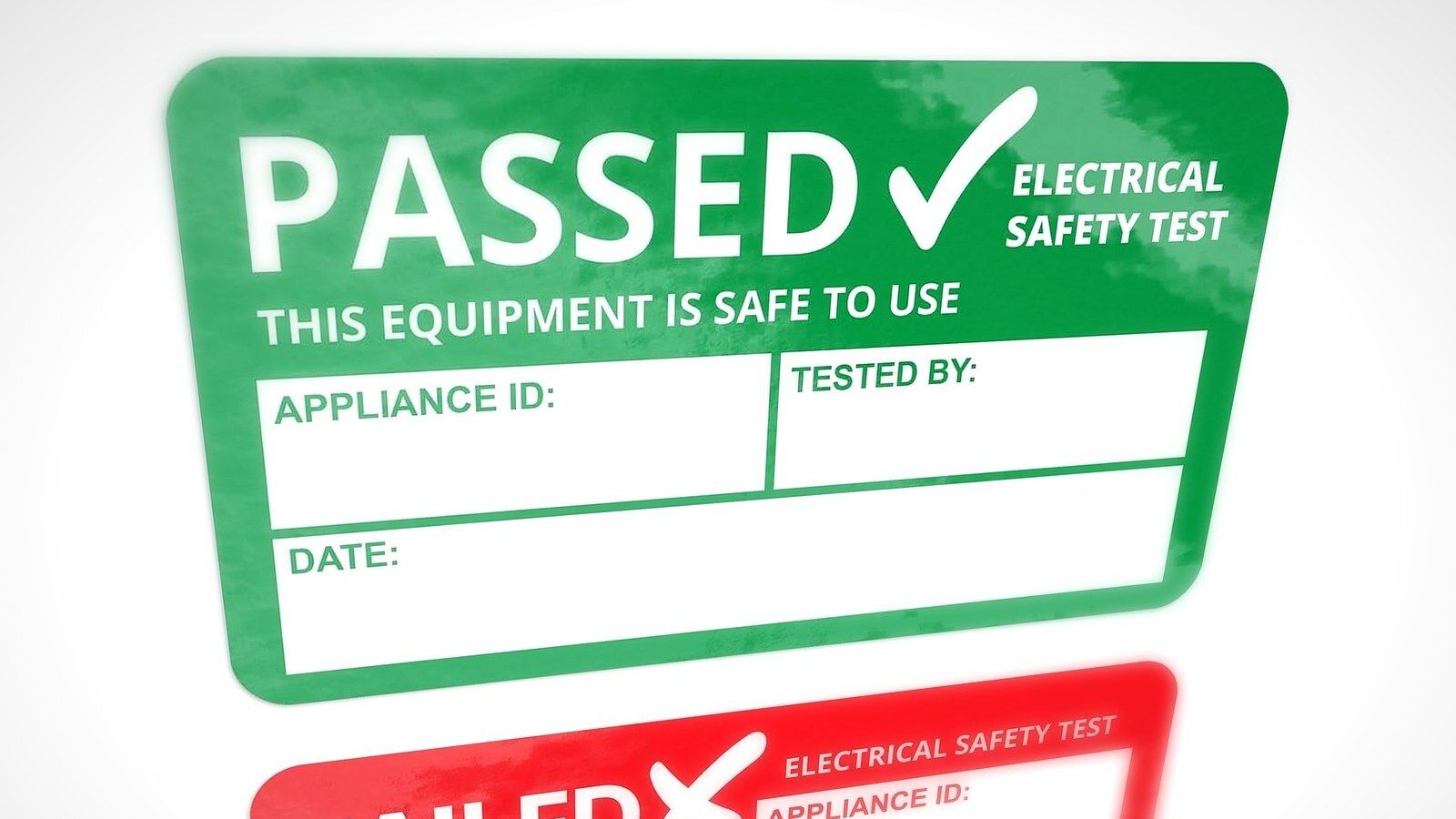
There is no legal requirement to label equipment that has been inspected or tested, or to keep records of it. HSE still suggests both, and for good reason: a register is the simplest evidence that you have done what the law asks, and it is what an insurer or a letting agent will want to see.
Landlords
In England there is no specific law that makes PAT compulsory in rented homes. The five-yearly electrical safety checks that private landlords must arrange cover the fixed wiring, not appliances; see EICR codes explained for those. Landlords must still make sure any appliances they supply, from a fridge to a microwave, are safe, and many HMO licences and letting agents ask for a PAT register. Testing the appliances you provide between tenancies, and keeping the register with your other safety records, is the easiest way to show you have taken care. Tenants’ own appliances are their responsibility.
Three levels of checking
User checks are what anyone should do before plugging something in: look at the cable, the plug and the casing for damage, scorch marks or loose parts, and stop using anything that looks wrong. They take seconds and find a large share of problems.
A formal visual inspection is done by someone trained to know what to look for. It includes opening the plug, where it is not moulded, to check the fuse is the right rating, the wires are on the right terminals, the screws are tight and the cord grip is holding the outer sheath of the cable. HSE points out that you do not need to be an electrician for this, but you do need enough knowledge to do it safely.
A combined inspection and test adds measurements with a PAT tester. It does not have to be done by an electrician either, but the person needs the right instrument and must know how to read the results.
Class I and Class II equipment
Class I appliances, such as kettles, toasters, irons and most desktop computers, rely on an earth connection. If a live wire touches the metal case, the earth carries the fault current and the fuse or RCD disconnects the supply. If the earth is broken, the case can become live without anyone knowing, which is why HSE recommends testing Class I equipment.
Class II appliances have extra insulation instead of an earth and are marked with a square inside a square. In a low-risk environment HSE says they do not need a PAT, only user checks and visual inspections, because the condition of the casing is what keeps them safe. If you cannot find the symbol, treat the item as Class I.
Battery-powered equipment and extra-low-voltage items, such as desk lamps running from a separate transformer, need no checks of their own; the charger or transformer that plugs into the mains does.
What the tests measure
The IET Code of Practice for In-service Inspection and Testing of Electrical Equipment sets out the tests and their limits.
- Earth continuity on Class I equipment: the resistance from the earth pin to the metal case should be no more than 0.1 ohm plus the resistance of the earth wire in the cable.
- Insulation resistance between the live parts and the case: at least 1 megohm for Class I and 2 megohms for Class II, normally measured at 500 V DC.
- IT equipment and anything with surge protection or filters is tested at 250 V, or with a leakage current test instead, so the test does not stress or trip its electronics.
- Polarity on extension leads and detachable power cords, to make sure live and neutral are not crossed.
The tests only show the condition of an item on the day. User checks still matter between visits.
How often
There is no fixed interval in law. INDG236 gives suggested starting points for low-risk premises, for example:
| Equipment | User checks | Formal visual inspection | Combined inspection and test |
|---|---|---|---|
| Desktop computers, monitors | No | Every 2 to 4 years | Not needed if Class II, otherwise up to every 5 years |
| Class II items moved occasionally, such as fans and table lamps | No | Every 2 to 4 years | No |
| Hand-held Class II items, such as some floor cleaners | Yes | Every 6 months to 1 year | No |
| Class I items such as kettles, irons, some floor cleaners | Yes | Every 6 months to 1 year | Every 1 to 2 years |
| Extension leads and chargers | Yes | Every 6 months to 4 years | Every 1 to 5 years, depending on what they supply |
Higher-risk places, such as building sites, workshops and commercial kitchens, need much shorter intervals. HSE also says the person doing the test should not decide when the next one is due: that decision belongs to whoever is responsible for the equipment, based on their own risk assessment. A good tester will suggest a date and explain why, and over time the results show whether you can check less often or need to check more.
New equipment should arrive safe from the supplier and does not usually need a test before use. Give it a quick visual check, an ID and a line in the register, so it is not missed next time.
What you should get
At the end of a visit you should have a label on each item tested, a register listing every item with its ID, location, class, results and suggested retest date, and a separate list of anything that failed, with the reason. A failed item should be labelled, taken out of use and either repaired by someone competent or disposed of.