NICEIC Registered
Guides
Electrical certificates and Part P
EIC, Minor Works or EICR, which electrical work has to be notified to building control, and what to keep for when you sell.
Published · Updated · By 2K Electrical Services
After any electrical work in your home you should get a document that says what was done and that it was tested. Which document depends on the size of the job. Some work also has to be reported to building control under Part P of the Building Regulations, which produces a second certificate. This guide explains the three documents electricians issue, which jobs need notifying, and why both matter when you sell. It covers England; Wales and Scotland have their own rules.
Electrical Installation Certificate (EIC)
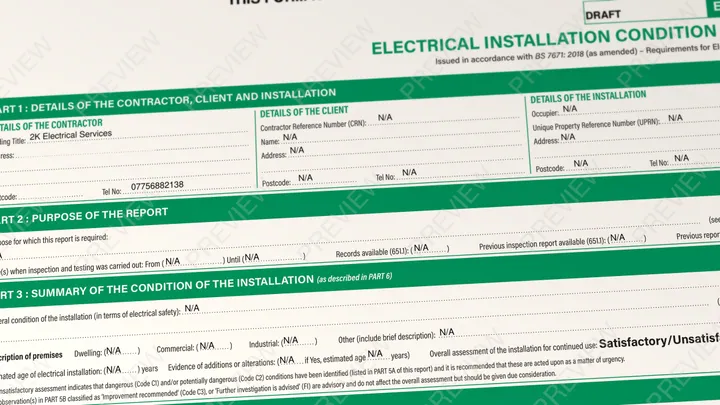
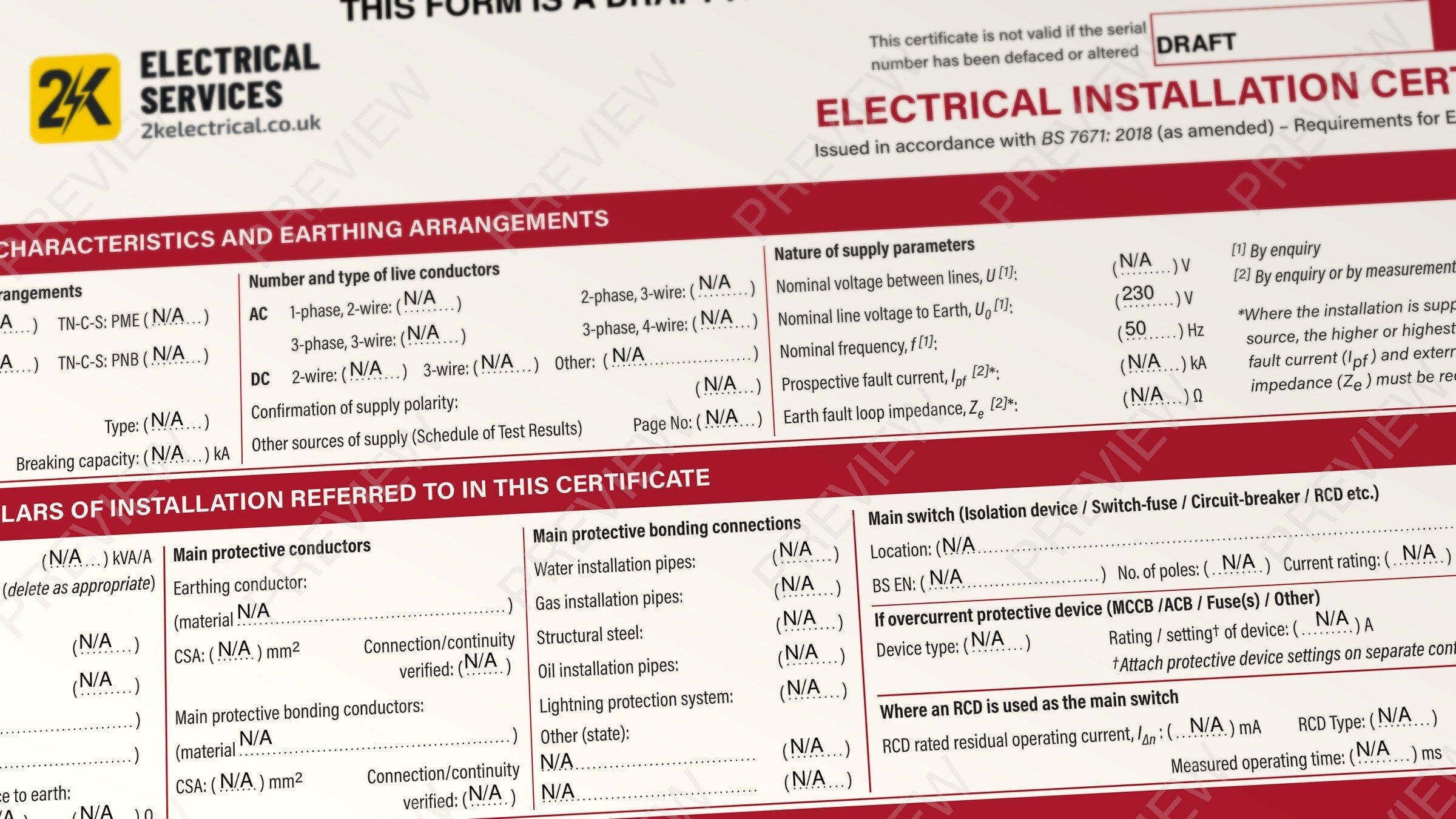
An Electrical Installation Certificate is issued for new work of any size: a new installation, a full or partial rewire, a new circuit, or a replacement consumer unit. It follows the model forms in BS 7671, the IET Wiring Regulations (currently BS 7671:2018+A4:2026), and is several pages long:
- declarations that the design, construction, and inspection and testing meet BS 7671, signed by the person responsible for each, or by one person if they did all three;
- a description of the work and of the supply and earthing arrangements;
- a schedule of inspections, a schedule of circuit details and a schedule of test results for every circuit involved;
- the designer’s recommendation for when the installation should next be inspected.
Minor Works Certificate
The Minor Electrical Installation Works Certificate is a one-page form for additions and alterations that do not include a new circuit: an extra socket on an existing circuit, a moved light switch, an extra light point. The electrician tests the circuit they worked on and records the results, including the protective device and any RCD protecting it.
EICR: a report, not a certificate
An Electrical Installation Condition Report checks the condition of an existing installation. It is not a certificate for new work and cannot be used instead of one. Anything found wrong is coded C1, C2, C3 or FI; see EICR codes explained. Repairs carried out after an EICR get their own EIC or Minor Works Certificate.
Which document for which job
| Job | Document from the electrician | Notifiable under Part P (England) |
|---|---|---|
| Replacing a consumer unit (fuse box) | EIC | Yes |
| Full or partial rewire | EIC | Yes |
| New circuit for an EV charger, electric shower, cooker or garden building | EIC | Yes |
| Extra socket or light point on an existing circuit, outside the bathroom zones | Minor Works | No |
| Any addition or alteration within the zones around a bath or shower | Minor Works, or EIC if a new circuit | Yes |
| Like-for-like replacement of a socket, switch or light fitting | Often none, though many electricians issue a Minor Works | No |
| Checking the condition of an existing installation | EICR | No |
Part P: which work must be notified
Part P of the Building Regulations has covered electrical safety in homes since 1 January 2005. Since the revised Approved Document P of April 2013, only three kinds of work are notifiable in England:
- installing a new circuit;
- replacing a consumer unit;
- any addition or alteration to an existing circuit in a special location, which means within the zones around a bath or shower, or in a room containing a swimming pool or a sauna heater.
Everything else, such as extra sockets in a kitchen or bedroom, outdoor lights on an existing circuit, repairs and like-for-like replacements, does not have to be notified. It still has to be done safely and to BS 7671. In Wales the rules are wider: kitchens and outdoor work are also special locations there.
How notification works
Through a competent person scheme. An electrician registered with a competent person scheme, such as NICEIC, can self-certify their own work. They tell the scheme, the scheme notifies the local authority, and within 30 days of the work being finished you should receive a Building Regulations Compliance Certificate, as well as the EIC from the electrician. You can check an installer on the government-authorised Competent Persons Register before the work starts.
Through building control. An installer who is not registered has to involve building control before starting: usually a building notice to the council at least two days before work begins, with a fee, after which building control inspects the work and issues a completion certificate. A registered third-party certifier is another option.
After the event. If notifiable work was done without either, the council’s building control can consider a regularisation application. Expect to pay a fee and to have the installation inspected and tested, which may mean opening up some of the work.
Why it matters when you sell
The property information form that sellers fill in for the buyer’s solicitor, the TA6, asks whether any electrical work has been done since 1 January 2005 and, if so, for the certificates. A missing Building Regulations Compliance Certificate for a new consumer unit or rewire can hold up a sale. The usual fixes are regularisation, an EICR to show the installation is safe now, or an indemnity policy that the buyer’s lender accepts. None of these is as quick as finding the original certificate.
What to keep
Keep every EIC, Minor Works Certificate and Building Regulations Compliance Certificate with the property deeds or in a folder you will not lose, together with any EICRs. Electricians and schemes can usually reissue a lost certificate, but only if you know who did the work. Landlords have extra duties to hand EICRs to tenants and the council, set out in EICR codes explained.